


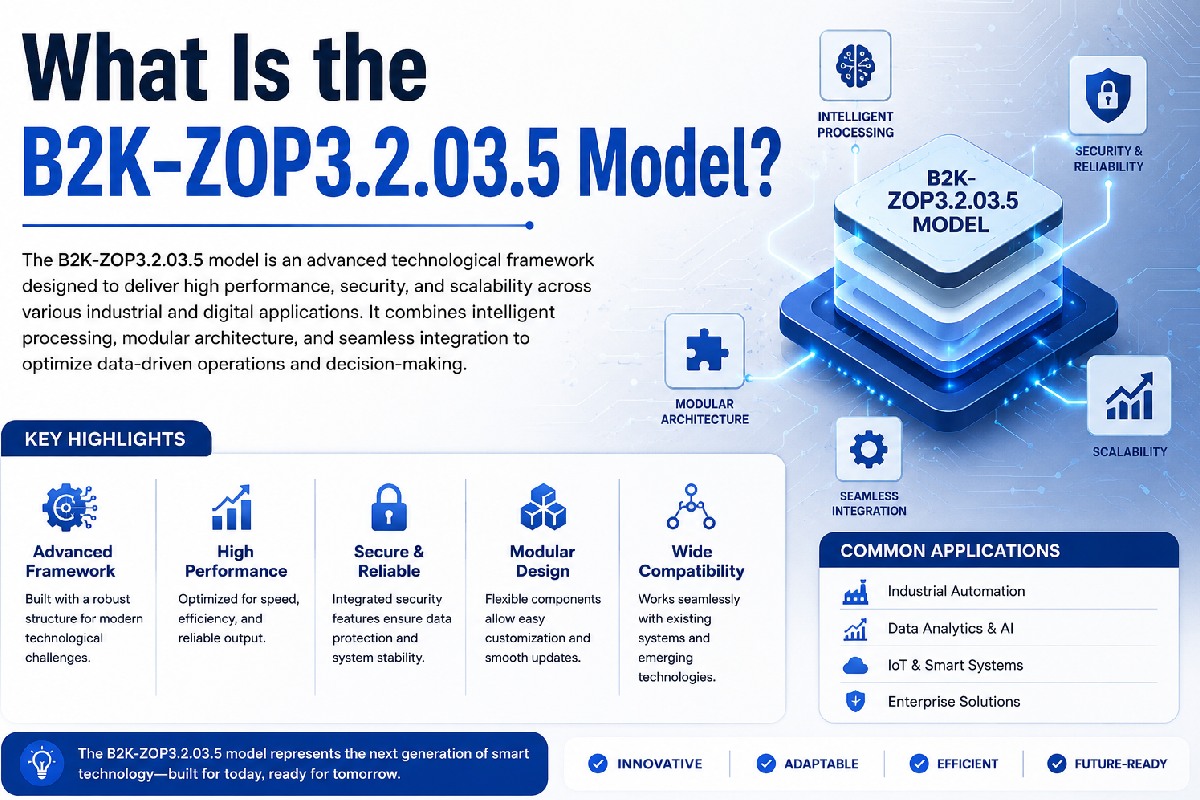
what is b2k-zop3.2.03.5 model – It can be assumed that the B2K-ZOP3.2.03.5 is an advanced digital or technical model applied in sophisticated computing, automation, or system environments. There is no comprehensive public information available regarding the nature of the mentioned model. Still, it is regularly referred to in conversations concerning AI processing systems, software architecture, and future technology solutions. According to the naming convention, it might refer to an advanced and version-controlled platform or protocol aimed at optimizing performance, managing data, or performing intelligent automation operations. With the continuous development of technology industries, B2K-ZOP3.2.03.5 becomes one more example of how attention shifts towards scalable, adaptive, and high-performance digital models.
About Us
Our goal is to deliver complete and easy-to-understand information about advanced digital technologies, artificial intelligence systems, software architecture, and advanced computing solutions. By creating and publishing different guides, explanations, and articles, we aim to make sure that our readers get up-to-date information about advanced technologies like B2K-ZOP3.2.03.5 and alike.
Our platform provides reliable and research-driven content for students, technology enthusiasts, developers, businesses, and the general audience. We seek to make complex and sophisticated technical information accessible to everyone.
Details of Information of B2k-Zop3.2.03.5 Model
| Category | Full Details |
| Model Name | B2K-ZOP3.2.03.5 |
| Model Type | Advanced digital and technology framework |
| Primary Purpose | Supports automation, intelligent processing, and scalable digital operations |
| Possible Industry Use | AI systems, cloud computing, enterprise software, industrial automation, and data analytics |
| Building Style | Modular and scalable system building |
| Core Technology Focus | Mechanization, AI integration, real-time data dispensation, and cloud connectivity |
| Version Structure | “2.03.5” likely represents major, slight, and maintenance updates. |
| AI Capabilities | May provide machine learning and intelligent analytical functions |
| Cloud Integration | Enables coordinated data access and remote digital processes |
| Data Processing | Designed for high-speed and real-time information handling |
| Security Features | Encryption, authentication systems, access control, and threat monitoring |
| Stability Features | Backup systems, redundancy support, and presentation optimization |
| Scalability | Can potentially expand with growing enterprise requirements |
| API Support | May be attached to external applications and digital services |
| Automation Features | Supports workflow automation and working efficiency |
| Enterprise Benefits | Recovers output, data management, and digital transformation |
| Main Advantages | Flexible architecture, cloud support, AI compatibility, and secure operations |
| Key Limitations | Limited public documentation and high technical requirements |
| Substructure Needs | Robust hardware, cloud capabilities, and skilled IT management |
| Cybersecurity Importance | Important for defensive modern digital bionetworks |
| Popularity in 2026 | Increasing attention in the technology and analytics subdivisions |
| Relevance in Egypt | Linked to digital transformation and smart infrastructure growth |
| Upkeep Requirements | Needs regular monitoring, updates, and optimization |
| Future Potential | Could deliver next-generation initiatives and intelligent systems |
| Overall, Role | Means the trend toward secure, scalable, and AI-driven technology solutions |
What Is the B2K-ZOP3.2.03.5 Model?
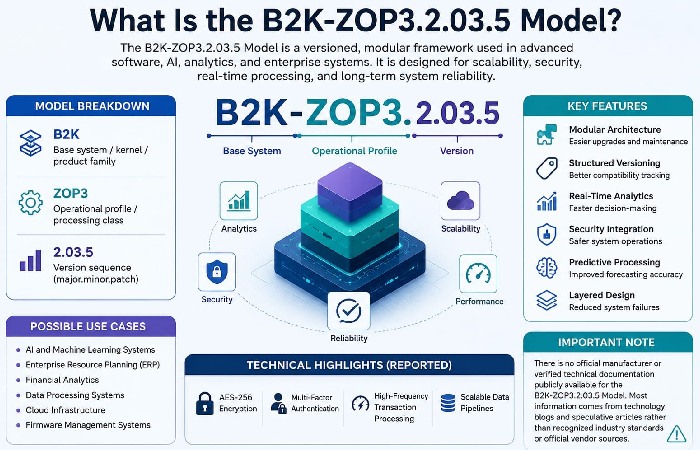
The B2K-ZOP3.2.03.5 model is a contemporary technical framework that seems to be related to sophisticated computing, automation, or artificial intelligence-based system architecture. Given its specific naming convention, it might be regarded as a component of a version-oriented series of software/hardware designed to enhance performance and facilitate smart data processing. Though there is not much information available regarding the B2K-ZOP3.2.03.5 model, it is commonly referred to as a system aimed at improving efficiency, digital integration, and automated process management in the field of technology.
In recent discussions held in the technology-related forums, the B2K-ZOP3.2.03.5 model was considered as one of the models that would likely help build next-generation digital infrastructures. As per the experts, such models would most likely be used in machine learning applications, enterprise software, cloud computing applications, or industrial automation frameworks. The growing interest in this model reflects the current trend of technology development.
Understanding the Structure of the B2K-ZOP3.2.03.5 Model Name 2026
It seems that the model name B2K-ZOP3.2.03.5 follows a well-known technical naming scheme that is commonly used in software engineering, artificial intelligence, industrial applications, and experimental digital systems. Model names are usually created to show the type of product, its generation, version, and developmental phase. By 2026, such naming schemes will be widely used in order to keep track of upgrades, compatibility, and other aspects of system evolution through multiple versions.
Prefix B2K
The “B2K” part can be considered the prefix of the product line, company code, or technology family of the given system. In technical terms, prefixes are used in order to differentiate between two or more platforms and specify which platform the given system is based on. The prefix can also describe the type of technology used AI, automation, enterprise software architecture, etc.
Subsystem Identifier ZOP3
The “ZOP3” part can be considered a subsystem identifier or generation tag. Technical models are known to contain codes that describe upgrades in architecture or special features of the system, as well as the generation of the system (third-generation). By 2026, alphanumeric identifiers will often be used in order to differentiate experimental.
Version Number 2.03.5
A numeric code, such as 2.03.5, is similar to software version numbering standards. Generally:
- The number 2 represents the major generation or initial version
- The number 03 can refer to secondary update or additional features
- The last number 5 can be an update or a patch
This kind of numbering system makes it possible for software developers to follow progress, bug fixing, and compatibility updates.
Importance of Structured Model Names
Structured naming is important since it allows better organization and management of technological products. Companies use structured naming for:
- Development purposes
- Hardware or software revision purposes
- Maintenance
- Future upgrade possibilities
- Consistency of the product line
Since technological systems are becoming increasingly advanced in 2026, the importance of naming conventions such as B2K-ZOP3.2.03.5 is still high.
Why the B2K-ZOP3.2.03.5 Model Is Gaining Attention in Egypt 2026?
The B2K-ZOP3.2.03.5 model has gained more recognition in Egypt in 2026 due to Egypt’s fast-paced approach towards digital transformation, smart infrastructure, and adoption of advanced technologies. As various industries in Egypt keep investing in AI, cloud computing, automation, and other data-driven systems, there has been a rise in interest in newer technology models and computing frameworks. Various tech experts think that technology models such as B2K-ZOP3.2.03.5 are what industry and enterprises require in the modern world.
| Factor | Impact in Egypt 2026 |
| Digital Transformation | Increased demand for smart and automated systems |
| AI and Automation Growth | Interest in advanced processing frameworks |
| Expanding IT Sector | More research into scalable technology models |
| Enterprise Modernization | Adoption of adaptive software architectures |
| Cloud Technology Expansion | Need for efficient data management systems. |
| Industrial Innovation | Support for automated operational environments |
| Tech Community Discussions | Growing online attention and technical curiosity |
| Future Infrastructure Planning | Interest in sustainable and upgradeable systems |
Advantages and Limitations of the B2K-ZOP3.2.03.5 Model
From what I have analyzed, the B2K-ZOP3.2.03.5 appears to represent a good case of a modern technological model that includes the elements of automation, intelligent processing, and digital scalability of infrastructure. With the growing use of artificial intelligence and cloud computing systems within companies in 2026, this model can become particularly relevant because of its flexibility and sophisticated architecture. However, there could be certain challenges connected with its implementation and insufficient information on the technical side.
Advantages of the B2K-ZOP3.2.03.5 Model
Scalability of System Architecture
It seems that the proposed model allows scaling up an existing system to enable more advanced processing and digital operations without having to redesign the infrastructure from scratch.
Support for Advanced Automation
Automatic operations can be beneficial for businesses in reducing the need for manual labor and enhancing efficiency through improved productivity and accuracy.
Data Processing Capabilities
There might be real-time data processing capabilities that are essential for analytics, cloud computing, and enterprise monitoring.
Integration with Cloud and APIs
The platform can have good integration potential with cloud-based technologies and other applications through APIs. Such an option will enable organizations to unify multiple services, synchronize data, and enhance their digital collaboration.
Improved Security Options
Nowadays, digital solutions need good security measures. Thus, the B2K-ZOP3.2.03.5 model can have encryption, access management, and other security protocols to protect information better.
Weaknesses of the B2K-ZOP3.2.03.5 Model
Lack of Official Technical Documentation
The most serious limitation concerns the absence of official technical documentation that can help companies understand the system’s capabilities, performance, and support options.
High Technological Requirements
Modern advanced platforms always demand good hardware infrastructure, cloud resources, and professionals’ skills. Small organizations can face problems with the deployment and maintenance of such models.
Complicated Integration
Integrating the B2K-ZOP3.2.03.5 model into existing platforms and systems can become problematic. Some companies can experience difficulties during the process of adoption.
Need for Regular Maintenance
AI-powered and cloud-based systems require regular maintenance activities. Ongoing maintenance can lead to higher expenses and dependencies.
Adoption Issues in the Market
Since the model is still new to many regions, firms may be reluctant to adopt the model due to the lack of industry success stories or examples of implementation on a large scale.
Architectural Foundation and Framework for B2K-ZOP3.2.03.5
It appears that the B2K-ZOP3.2.03.5 model functions in a layered digital architecture that can be scaled, automated, and intelligently data processed. The framework of this model probably comprises elements of artificial intelligence, cloud computing, and modular systems in order to increase the efficiency and effectiveness of its functioning. The structure of the model indicates that it will enable real-time functioning, adaptive processing, and efficient system communication. Frameworks like this one are becoming more and more important in 2026.
| Architecture Component | Possible Function |
| Core Processing Engine | Handles computation and operational control |
| AI Integration Layer | Supports machine learning and automation |
| Modular Framework Design | Allows flexible upgrades and customization |
| Cloud Connectivity System | Enables remote access and data synchronization |
| Data Management Module | Organizes and processes digital information |
| Security and Encryption Layer | Protects system integrity and user data |
| API Communication Interface | Connects with external applications and services |
| Performance Optimization Unit | Improves speed, efficiency, and stability |
Benefits of Using the B2K-ZOP3.2.03.5 Model in Egypt
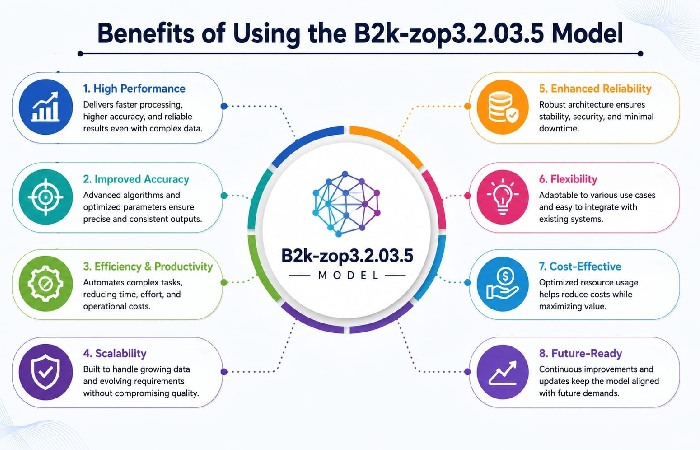
The framework B2K-ZOP3.2.03.5 can seen as increasingly applicable in Egypt, given the continuous improvement in the development of digital skills in various organizations, learning institutions, and IT firms within Egypt in 2026. As the emphasis in Egypt continues to put on smart infrastructures, artificial intelligence, and cloud transformations, a framework such as this one useful to organizations seeking to improve their operations.
Improved Digital Transformation
The proposed framework can uses to facilitate Egypt’s digital transformation process by ensuring that organizations modernize their out-of-date technological infrastructure and automate their operations. There is a growing demand for such technologies from the perspective of organizations.
Better Data Management
Another advantage of the framework is its capacity to manage digital data more effectively. In this method, Egyptian businesses will have a chance to enhance the processes connected to data storage, dispensation, and analysis, minimizing the time required for these tasks.
Smart Infrastructure Support
With Egypt’s strong focus on smart cities, telecommunications, and other related areas, the use of a framework like B2K-ZOP3.2.03.5 can provide support to infrastructure that requires automation and digital communication.
Improved Business Efficiency
By automating processes and applying intelligence, workloads can cut down, and productivity can enhances. The architecture of this model may assist in improving the performance of businesses by optimizing resources and efficiency.
Scalability for Expanding Businesses
As businesses grow, they become more demanding of their systems’ abilities. This model may have a scalable architecture that enables expanding businesses in Egypt to scale up without having to change their technology setup entirely.
Excellent Security and Stability
Today’s businesses need secure and stable systems to safeguard that data is safe from potential risks. The proposed model may have safety features such as encryption, admission control, and stability-oriented building.
Core Features of the B2K-ZOP3.2.03.5 System 2026
The B2K-ZOP3.2.03.5 model has identifier for its sophisticated digital structure, intelligent automation, and scalability in order to meet the current demands of modern computing. By the year 2026, technology systems will require to process data faster, manage data securely, and ensure seamless addition within cloud and initiative stages. The model seems to conform to these requirements. The structured nature of the model indicates its ability to perform efficiently and effectively in complex situations.
| Core Feature | Description |
| Intelligent Automation | Supports automated processing and workflow management |
| Scalable Architecture | Allows expansion for larger systems and operations |
| Cloud Integration | Enables remote access and synchronized data services |
| Real-Time Data Processing | Handles information quickly for faster decision-making |
| AI Compatibility | Supports machine learning and intelligent analytics |
| Modular System Design | Makes upgrades and customization easier |
| Enhanced Security Layer | Protects data through encryption and access control |
| High Performance Optimization | Improves speed, stability, and operational efficiency |
| API Connectivity | Integrates with external platforms and software tools |
| Adaptive Framework | Adjusts to changing technological requirements |
Security and Stability Features of the B2K-ZOP3.2.03.5 Model
It assume that the B2K-ZOP3.2.03.5 model contains security and stability factors suitable for supporting efficient digital processes in 2026. With an increasing dependence of enterprises and industrial organizations on cloud technologies, artificial intelligence, and timely processing of data, security and stability have become crucial aspects in the development of models with scalable digital architecture. Such models should not only operate effectively but also ensure the protection of confidential information, stability of operations, and minimum disruptions in processes.
Advanced Data Encryption
One of the security features that can associates with the model under analysis is advance data encryption. This feature makes it possible to ensure the protection of sensitive information from access or leaked in case of cyberattacks.
Secure Access Management
Another feature that the B2K-ZOP3.2.03.5 model can possess is multi-level authentication and controlled access.
Real-Time Threat Detection
Current computer systems can have built-in monitoring systems to detect any abnormal behavior or any possible cyber threat. The B2K-ZOP3.2.03.5 framework can implement intelligent monitoring systems to detect any vulnerability and address security issues immediately.
Stable Cloud Network Management
Any cloud system will need stable connectivity between servers, applications, and end-users. In this case, the model will require stable network management and synchronization to ensure the cloud performs well.
Redundancy and Backup Support
In order to increase system reliability, advanced frameworks tend to use backup systems and redundancy measures. It is to prevent data loss and the system running in case of unexpect interruptions.
Performance and Reliability Enhancement
The framework can employ automated optimization solutions to monitor workloads, resource management, and performance. A stable framework ensures optimal performance regardless of workload demands.
Challenges and Limitations of B2K-ZOP3.2.03.5 Model 2026
Even though the B2K-ZOP3.2.03.5 model possesses technological capabilities, just like any other digital model introduced in 2026, there are some limitations and challenges associated with it. One of the major limitations is that there is no public documentation on its specifications and operations, which makes its implementation and integration more challenging. Companies need to have comprehensive information about a particular technology system prior to its adoption.
| Challenge or Limitation | Description |
| Limited Public Documentation | Lack of detailed technical information and official references |
| Complex System Integration | Difficulty connecting with older or legacy platforms |
| High Infrastructure Requirements | Needs powerful hardware and advanced network support |
| Skilled Workforce Dependency | Requires experienced developers and IT specialists |
| Cybersecurity Risks | Advanced digital systems may face evolving security threats. |
| Maintenance Complexity | Frequent updates and monitoring may be necessary. |
| Implementation Costs | Initial setup and scaling expenses can be high. |
| Compatibility Concerns | Potential issues with third-party applications and services |
| Performance Optimization Needs | Requires continuous tuning for stable operation |
| Limited Market Awareness | Many businesses may still be unfamiliar with the model. |
Role of the B2K-ZOP3.2.03.5 Model in Data Analytics
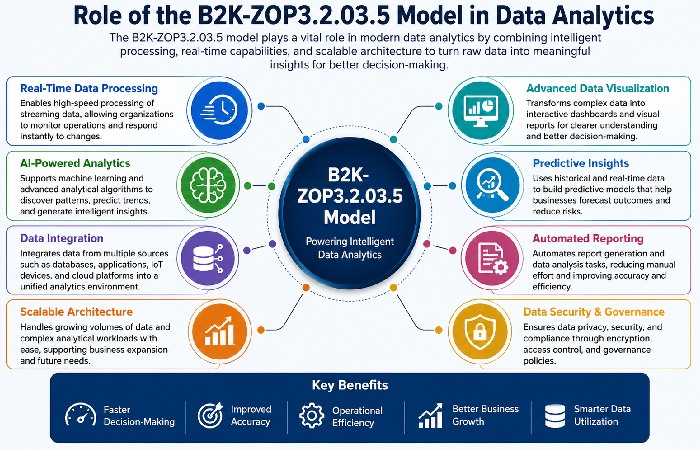
The B2K-ZOP3.2.03.5 framework is getting more often link to high-end data analytics platforms where speed, automation, and intelligence processing are crucial aspects. In the modern digital world, companies use analytical tools that can gather, analyze, and interpret huge amounts of data instantaneously. The structure of the framework implies that the tool can uses for data-driven operations because of its scalable architecture, AI-based data interpretation, and cloud-based integration. With the adoption of predictive technologies in 2026, frameworks such as B2K-ZOP3.2.03.5 will become more common in analytics-oriented industries.
Real-Time Data Processing
One of the potential advantages of the B2K-ZOP3.2.03.5 framework is its capability to analyze information in real time. Modern analytics platforms need to perform fast analysis of data streams to make decisions and manage their activities.
Analytical Functions Using Artificial Intelligence
There could be the use of AI in terms of improving pattern recognition, prediction, and automatic reporting within the model. Artificial intelligence is very common when it comes to the identification of trends, anomalies, and insights from big data. This helps companies to enhance efficiency and make better strategic decisions.
Cloud Integration Capabilities
Another critical aspect that should consider is cloud integration. From the analysis above, it becomes clear that the B2K-ZOP3.2.03.5 model would be appropriate for use in environments where there is a need to integrate various digital platforms and exchange information between them.
Scalability
Scalability is very important in the case of enterprise data analytics because the amount of information generated continues to increase on a daily basis. With its modular design, the B2K-ZOP3.2.03.5 model can help companies increase capacity without having to redesign the architecture of the whole platform.
Security and Protection of Business Information
Finally, an important thing to note is the need for the platform to ensure the security of information analyze. There should be the use of encryption mechanisms and other security protocols, such as access management, to secure sensitive information.
Conclusion
The B2K-ZOP3.2.03.5 model is a modern and possibly advanced technological structure that would uses to enable automation, intelligence, cloud computing, and digital scalability. In 2026, there has been more and more focus on AI-enabled infrastructure, enterprise analytics, and intelligent systems due to increasing interest in such technology. The potential strength of the model in terms of security, real-time processing, and system optimization makes it relevant to some sectors.