


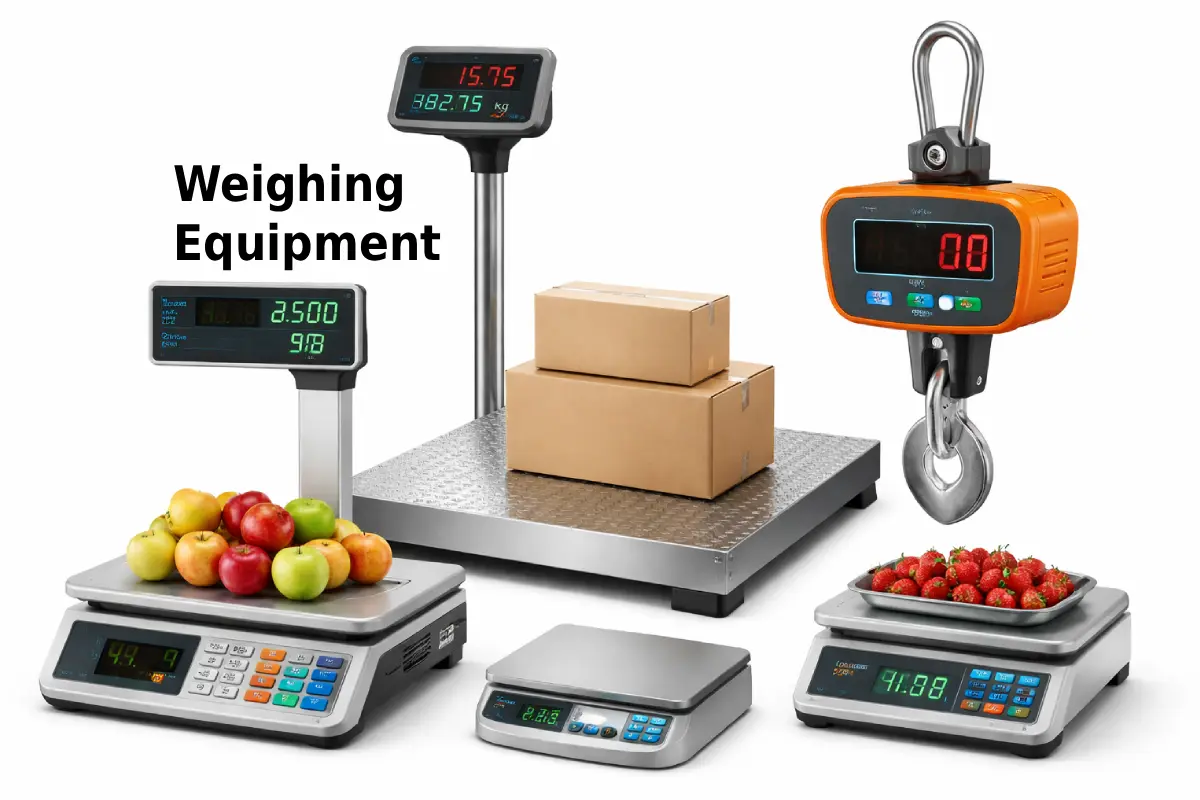
Settling on the right choice of weighing scales is important for many businesses that require dependable weight measurements as part of their manufacturing, processing, packaging, warehousing, or other industrial operations.
Inevitably, however, different applications and situations call for different industrial weighing equipment. Such factors as capacity, the level of precision required, and the environment in which the scales will be used need to be factored in by decision-makers.
This article, then, will spotlight some of the industrial weighing systems that organisations operating across such sectors as manufacturing, logistics, food processing, and pharmaceuticals are likely to consider.
Bench Scales
Bench scales are compact and versatile weighing devices designed to sit on an elevated, flat surface such as a workbench, tabletop, or counter.
Filling the practical gap between high-precision laboratory scales and heavy-duty floor scales, bench scales can be particularly useful for weighing relatively small or medium-sized items in a convenient location.
This helps make such devices a popular investment for organisations needing to undertake packaging, stock control, parts handling, and general manufacturing tasks. Some models lend themselves well to parts-counting functions, too.
Platform Scales
When the need exists to weigh larger and heavier loads than many bench scales can handle, platform scales are likely to rise to the task.
These heavy-duty or commercial weighing devices typically feature flat and low-profile metallic surfaces. This makes them suitable for the weighing of bulky objects, boxes, containers, and similarly oversized or hefty items.
This type of weighing equipment is commonly used in manufacturing facilities, warehouses, and other commercial and industrial settings.
Counting Scales
Effectively combining weighing and parts-counting functions, counting scales are specialised electronic machines designed to calculate the quantity of identical or similar items based on their weight.
This type of weighing equipment works as follows: instead of having to manually count potentially thousands of small parts by hand, the operator places a bulk load on the scale. The device then automatically divides the total weight by the average weight of a single piece, so that it can display the total count.
Unsurprisingly, then, counting scales are much appreciated in environments where large quantities of small, similar components need to be handled. This encompasses such processes and tasks as inventory management, picking, packaging, and stock control.
Precision Balances and Precision Scales
These high-performance weighing instruments are designed for applications requiring greater readability and weighing performance than many general-purpose scales can provide.
Depending on the model and manufacturer, precision balances may offer readability from around 1g down to 1mg. However, specifications vary considerably between products.
Precision balances and precision scales are commonly used in laboratories, quality control, research and development, and manufacturing applications where relatively small quantities need to be weighed.
Hanging And Crane Scales
The names of these specialised weighing instruments already largely indicate how they operate. Specifically, they are designed not to weigh objects placed on a platform, but instead when they are suspended from above.
While the terms “hanging scales” and “crane scales” are often used interchangeably in industrial contexts, they don’t refer to exactly the same thing.
The term “hanging scales” can refer to a broad range of suspended-load weighing devices. “Crane scales”, meanwhile, are a type of hanging scales generally intended for heavier industrial loads.
Compact And Portable Scales
Weighing doesn’t always have to happen at a fixed workstation. Indeed, when space is limited or equipment needs to be moved from one location to another, compact and portable scales can be very useful.
As one might expect, the devices in this category are relatively lightweight and modestly proportioned for easy portability. So, these digital scales can be suitable for weighing relatively light items, samples, or components.
Having access to portable scales can be especially important in maintenance, inspection, laboratory, and production environments where measurements need to be taken at different locations.
Conclusion: Finding Suitable Industrial Weighing Equipment
There isn’t any single type of weighing scale that represents the ideal match for every conceivable industrial application.
This underscores the importance of organisational decision-makers accounting for a range of factors as they attempt to whittle down their options.
By considering such aspects as capacity, readability, construction, functionality, operating environment, and calibration requirements, organisations can help ensure they choose the weighing equipment that represents the best match to their day-to-day operations.