


Conversations about IT strategy usually start in the wrong place. They start with the technology — what needs upgrading, what’s approaching end of life, what new platforms are worth evaluating. The budget ask gets built from the technology assessment, and then leadership has to evaluate a cost request that doesn’t clearly connect to anything they’re trying to accomplish.
The conversation that would actually be useful starts with the business: where are we going, what do we need our technology environment to enable, and what’s it worth to us to build that environment deliberately rather than by accident? Starting there changes both the content of the strategy and how it lands with the people who have to approve it.
Why Technology Strategy Has a Measurable Return
The resistance to investing in IT strategy usually rests on a perception that it’s overhead — a planning cost that supports other investments rather than generating returns itself. That perception is wrong in most cases, but it requires a different kind of analysis than most organizations apply.
The return on strategic technology planning shows up in at least three ways.
First, better decisions. Technology decisions made against a clear strategy are better decisions than those made reactively. They’re better evaluated, better sequenced, and better connected to actual business needs. The cost of avoiding one significant technology mistake — a platform adoption that has to be reversed, an integration decision that creates years of data management problems, a security gap that leads to a breach — typically exceeds the cost of the strategic planning that would have prevented it.
Second, avoided costs. The technical debt that accumulates when technology grows without direction is expensive to maintain and expensive to resolve. Reactive technology environments require more ongoing management, more firefighting, and eventually more remediation than planned ones. The businesses that invest in strategic planning tend to have lower ongoing IT costs per employee than those that don’t, even after accounting for the planning investment.
Third, faster execution. Organizations with clear technology strategies move faster on decisions that would otherwise require extensive deliberation. The evaluation criteria are established. The architecture principles are defined. The priorities are set. This reduces decision latency across the organization in ways that compound at scale.
What IT Strategy Consulting Brings That Internal Planning Doesn’t
Most organizations have people who can think about technology. What they often don’t have is the combination of expertise and perspective that makes strategic planning genuinely effective.
Pattern recognition. A consultant who’s worked across many organizations has seen which technology investments tend to produce strong returns, which common architectural decisions create problems at scale, and what the path from a given current state to a given target state typically looks like. This pattern library is hard to build internally and hard to replicate from research alone.
Business-technology translation. Strategic technology planning requires fluency in both business and technology — the ability to start with a business objective and derive technology implications, and to translate technology recommendations back into business terms that leadership can evaluate. This translation skill is rarer than either business or technology expertise alone.
Structural methodology. Good strategy requires a process, not just expertise. A structured approach to assessing current state, identifying gaps, defining target state, and sequencing initiatives produces more actionable output than a free-form analysis, even if both are conducted by knowledgeable people.
Effective it strategy consulting combines all three of these elements — and the combination produces strategy that’s more actionable and more durable than what most organizations can generate internally.
Building the Case Inside Your Organization
One of the practical challenges in advancing IT strategy work is building internal support for the investment. This requires translating the value of strategic planning into terms that resonate with different stakeholders.
For financial leadership, the most compelling argument is risk management. The cost of strategic IT planning is predictable and bounded. The cost of the problems it prevents — security incidents, technology failures, expensive reversals of poor technology decisions — is unpredictable and potentially large. The expected value of prevention is typically favorable even under conservative assumptions.
For operational leadership, the argument is decision quality and speed. A clear technology strategy means technology decisions don’t require lengthy deliberation every time. Teams can act faster because they have a framework to work from. And they make fewer decisions that need to be revisited.
For the executive team, the argument is alignment. Technology that’s built to support business strategy is more likely to actually support it. The disconnect between technology investment and business outcomes is often a symptom of strategy built from the technology outward rather than from the business inward.
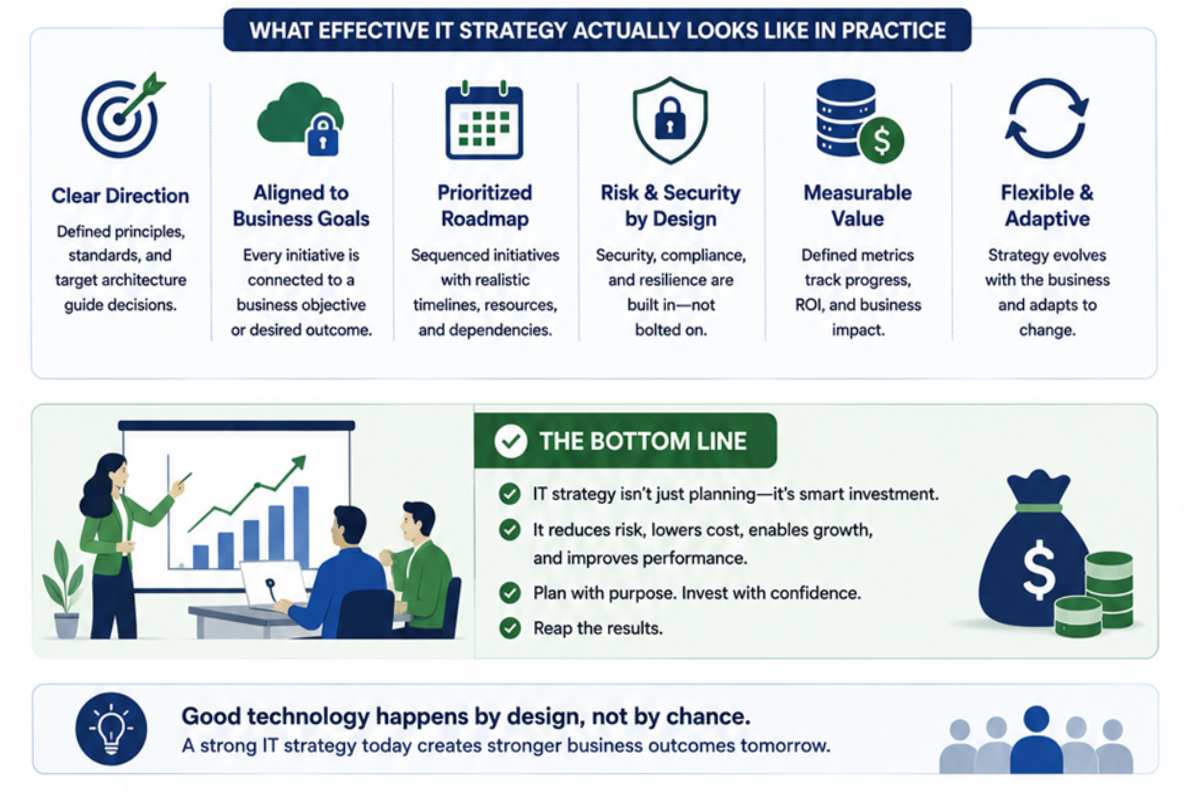
What Effective IT Strategy Actually Looks Like in Practice
An effective IT strategy is specific enough to make decisions against and flexible enough to accommodate change. That’s a narrower target than it sounds.
Specificity means real commitments: these are the platforms we’re standardizing on, this is our cloud architecture, this is our security baseline, this is the sequence of investments over the next eighteen months, and this is how we evaluate trade-offs when new needs arise. Vague strategies that articulate principles without making commitments don’t help anyone make decisions.
Flexibility means the strategy includes a governance process for updating it when circumstances change — because they will. New competitive dynamics, changes in the regulatory environment, shifts in business direction, new technology capabilities: all of these can invalidate specific strategic choices without invalidating the overall framework. The strategy needs a mechanism for staying current.
Finally, an effective strategy has owners. Someone is accountable for executing against it, measuring progress, and bringing relevant updates to leadership. Without that accountability, even a well-designed strategy becomes a document rather than a management tool.
IT strategy is one of the few planning investments where the ROI case is genuinely compelling once it’s properly constructed. The question isn’t whether strategic technology planning creates value — the evidence for that is substantial. The question is whether your organization is capturing that value or leaving it on the table.