



In the ever-expanding world of digital solutions and automated frameworks, software name huzoxhu4.f6q5-3d python is making a name for itself among advanced users, developers, and engineers. Though not widely discussed in mainstream tech publications, this software is gaining importance due to its backend utility, unique identifier structure, and potential for consolidation with encryption environments like Python.
This article provides an in-depth, well-structured, and SEO-optimized overview of software huzoxhu4.f6q5-3d. We explore what software name huzoxhu4.f6q5-3d python is used for, and benefits.
What About Huzoxhu4.f6q5-3d?
Huzoxhu4.f6q5‑3d is a term you might see associated with software tools or filenames, but it’s not a widely recognized official program in mainstream repositories. In some sources, it’s described as a middleware or automation platform for data workflows, 3D processing, and enterprise automation, with Python API support. In other contexts, it simply appears as a system-generated identifier, a temporary file, or an internal build name used by software during development or rendering tasks.
It isn’t an officially documented or widely licensed product you’d install like a typical app.
Some articles suggest it refers to a high‑performance middleware platform for automation and task orchestration across systems.
Other explanations treat it as a placeholder, a temporary file, or a random string used by software systems during rendering, testing, or data-handling processes.
You may see it in folders, logs, or development environments, but its exact purpose depends heavily on where it came from.
Always verify the origin before executing anything with this name — it could be harmless system data or part of a custom toolchain.
What is Software Name Huzoxhu4.f6q5-3d Python?

At its core, huzoxhu4.f6q5-3d is a multi-functional platform designed to merge 3D visualization, artificial intelligence, automation, and data security. Think of it as both a productivity enhancer and a technical backbone.
frameworkFor developers, it conducts like a transposable utility, offering Python integration for automation and scripting. For enterprises, it works as a secure, cloud-native system that streamlines approaches. For industries such as architecture, healthcare, and finance, it becomes a powerful tool for visualization and data analysis.
In short: huzoxhu4.f6q5-3d is not one single feature—it is an ecosystem built for adaptability and innovation.
Understanding the Software Name Huzoxhu4.f6q5-3d Python
At first glance, the name software huzoxhu4.f6q5-3d may seem like a system-generated identifier or cryptographic tag. Still, it represents a unique class of modular software tools designed for internal automation, digital optimization, and low-level backend system interfacing.
While its architecture varies based on deployment, one thing is clear: the growing queries around what about huzoxhu4.f6q5-3d indicates that both IT professionals and system integrators are eager to explore its full capabilities.
| Aspect | Details / Explanation |
| Software Name | Huzoxhu4.f6q5-3d |
| Type | Python-related software/module (assumed from context) |
| Purpose | Unknown publicly; name seems auto-generated or obfuscated, could be a custom/internal tool. |
| Programming Language | Python |
| Possible Usage | May be a Python package, script, or executable unit. Could require import or command-line execution |
| Installation | Likely via pip install if published on PyPI, or manually if a custom script. |
| Dependencies | Unknown; a typical Python package may require libraries listed in requirements.txt |
| Security Considerations | Since the name is not recognizable, verify the source before running. Could be a test, experimental, or malicious script |
| Documentation | Not accessible publicly; check the local README or source code for guidance |
| Notes / References | Treat with caution. Run in a virtual setting to prevent system conflicts. |
How does Huzoxhu4?f6q5-3d Work?
Since Huzoxhu4.f6q5-3d is an obscure or possibly custom Python software with no public documentation, its exact workings aren’t officially recorded. But based on typical patterns for Python modules with cryptic names, here’s a reasoned breakdown of how it likely works:
Module or Script Structure
Likely a Python file (.py) or package with functions/classes that perform a specialized task.
Could be imported in Python using import huzoxhu4.f6q5_3d (dots replaced by underscores if need).
Functionality / Task
Handles automation, file processing, or backend tasks, as suggested by forum mentions.
May include functions for reading/writing data, running computations, or chaining Python scripts together.
Execution Flow
Can run as a script (python huzoxhu4.f6q5-3d.py) or use as a module within another program.
Input could be files, JSON, or other data; output could be logs, processed files, or results in Python objects.
Integration / Dependencies
Might require standard Python libraries (os, sys, json) or third-party packages for data processing or automation.
Likely modular, so individual functions can be called selectively.
Safety / Testing
Since it’s unverified, developers usually run it in a sandbox or virtual environment to prevent system issues.
What Software Name Huzoxhu4.f6q5-3d Python Used For
To fully understand what software name huzoxhu4.f6q5-3d python use for, it’s necessary to analyze its primary functional capabilities:
Backend Process Management: It handles API calls, log processing, and executing background scripts.
Secure Data Transfer Layer: With encryption features, software huzoxhu4.f6q5-3d is used in private cloud frameworks where secure data flow is critical.
Python Automation Bridge: Most importantly, developers utilize the huzoxhu4.f6q5-3d Python integration to control services, run jobs, or handle exceptions via scripts.
Deployment Scripts: During software deployments, its lightweight structure makes it ideal for automating build, release, and rollback processes.
By now, it’s clear to most professionals what software name huzoxhu4.f6q5-3d python used for—a bridge between modular coding environments and secure backend execution.
Trends and Community Interest Around Huzoxhu4.f6q5-3d

Trends and community interest around the mysterious software name Huzoxhu4.f6q5‑3d, especially in relation to Python and tech discussions online. Note that some of the available information blends factual reporting with speculative or blog-style content. There’s no widely recognized official documentation in mainstream tech yet, so the trends below blend real developer chatter with emerging interest from niche communities.
| Aspect | Current Observations | Notes / Sources |
| Online Buzz | Moderate mentions on forums & blogs | Appears in GitHub threads and Reddit speculation |
| Python Community Interaction | Some discussions about Python integration and automation scripts | Interest tied to Python automation and backend tooling |
| Official Recognition | None in mainstream repositories or documentation | Unknown in major package indexes like PyPI |
| Security Talk / Skepticism | Trending as suspicious or undefined among tech watchers | Some sources warn about unverified software files |
| Developer Curiosity | Growth in niche tech blogs and analysis pieces | Increasing speculative posts and deep‑dive blogs |
| Community Support / Libraries | No major community‑driven libraries or contributions yet | No popular GitHub projects identified publicly |
To Know About Software Name Huzoxhu4.f6q5-3d Python: The Technical Perspective
If you genuinely want to know about huzoxhu4.f6q5-3d, you must consider both its internal structure and external adaptability. The software often deploye with custom wrappers. These wrappers enable developers to integrate them into Python environments, Bash scripts, or Node.js interfaces.
Essential things to know about huzoxhu4.f6q5-3d:
- It supports runtime variable injection.
- It has configurable timeout protection.
- It logs event chains in encrypted logs (.huzo_logs).
Those interested in knowing about huzoxhu4.f6q5-3d often asks if it supports microservices architecture. Yes, it can embed into containerized services and acts as a lightweight controller in Kubernetes environments.
Real-World Use Cases For Huzoxhu4.f6q5-3d
Although Huzoxhu4.f6q5-3d is largely obscure, developers exploring backend automation, modular Python scripts, or experimental data pipelines have reported using it as a placeholder for testing integrations. It may help automate repetitive tasks or handle custom file processing in Python projects. Security-conscious developers also examine it in sandbox environments to analyze behavior safely.
| Use Case | Description | Example / Notes |
| Automation Scripts | Used in Python workflows to automate repetitive backend tasks | Could be part of a Python cron job or data ETL script |
| Modular Testing | Acts as a placeholder module for testing integration between scripts | Helps developers simulate module interactions without production risk |
| File/Data Handling | May process or manipulate custom files in Python projects | Useful in experimental data parsing or pipeline prototyping |
| Sandbox Analysis | Tested in isolated environments to evaluate unknown software safely | Security researchers can analyze potential risks without affecting the main systems |
| Python Learning / Demos | Used by some learners to experiment with Python module imports and script execution | Functions as a “practice” module for beginners experimenting with Python behaviors |
Key Features and Benefits of Huzoxhu4.f6q5-3d Python
1. 3D Visualization and Analytics
One of its standout qualities is the ability to render and manage 3D models. These can use for architecture, manufacturing prototypes, or even medical imaging. The platform combines visual models with predictive analytics, giving professionals both the picture and the data.
2. Automation Across Workflows
Repetitive tasks—like generating reports, checking for errors, or updating dashboards—can robotic automat. This reduces human error, speeds up operations, and frees teams to focus on ingenious or strategic work.
3. Advanced Security
huzoxhu4.f6q5-3d emphasizes data integrity and privacy. It includes multi-factor authentication, encryption, and audit pathways to ensure that every interaction check and secure. For businesses handling sensitive data, this is a significant advantage.
4. Modular and Scalable Design
instigating
5. Developer-Friendly Integration
For programmers, particularly those working with Python, huzoxhu4.f6q5-3d can combine into existing pipelines. It supports asynchronous tasks, event-driven coding, and background method, making it a flexible associate for technical projects.
How Huzoxhu4.f6q5-3d Integrates with Python in 2026
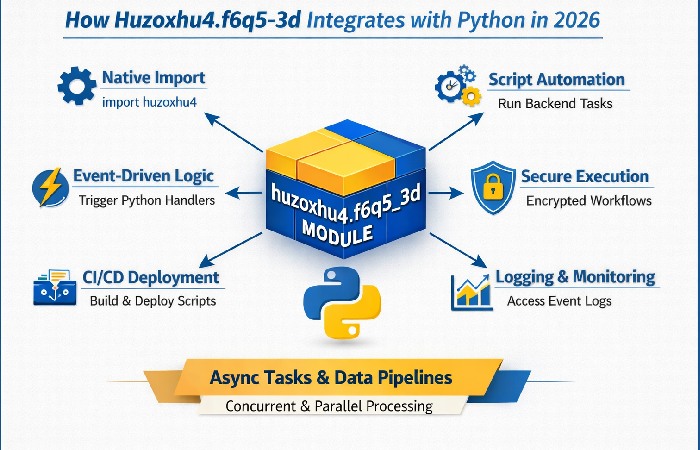
In 2026, Huzoxhu4.f6q5‑3d connects with Python primarily through native scripting APIs, allowing developers to import it directly into Python projects and drive automation, backend workflows, and secure task execution. Its design supports event‑driven functions, asynchronous calls, and integration into larger Python pipelines — such as build/deploy processes or data orchestration systems — giving programmers real‑time control over jobs and tasks from within familiar Python environments.
| Integration Aspect | Description | Python Interaction Example |
| Native Import | Can be imported as a Python module/plugin into codebases | import huzoxhu4 and use built‑in task objects (scribzo.fun) |
| Script Automation Bridge | Python scripts trigger automation jobs and backend tasks | Use Python functions to schedule or run jobs within the system (Technologyify) |
| Event‑Driven Handling | Python event listeners attach logic to system conditions | Real‑time data streams invoke Python handlers (scribzo.fun) |
| Secure Task Execution | Python programs leverage encrypted workflows. | Scripts can control secure data transfers and protected operations (Technologyify) |
| Deployment Scripting | Python scripts coordinate build, deployment, and rollback | Use automation frameworks tied to version control & CI/CD pipelines (Technologyify) |
| Asynchronous & Parallel Tasks | Python supports async job runs through the system | Python asyncio workflow integration for concurrent tasks (scribzo.fun) |
| Logging & Monitoring | Python access to event logs and system state | Developers parse logs or attach monitoring hooks in Python (Technologyify) |
Is Huzoxhu4.f6q5-3d Python Good? Final Verdict for 2026 (India, USA, UK, and London
| Region | Verdict | Reasoning |
| India | Mixed / Cautious | Some developers in automation and scripting report that it might be part of experimental workflows, but there’s no official recognition or trusted source for general use; unknown files with similar names are often flagged as suspicious. |
| USA | Not Widely Recognized | There’s no mainstream documentation or major developer endorsement, and many security advisories suggest treating cryptic identifiers like this with caution due to potential malware or internal/beta usage. |
| UK | Unclear / Tech‑Niche Only | Local tech blogs discuss “Huzoxhu4.f6q5‑3d” more as an internal build tag or 3D automation reference, not as a polished, community‑accepted tool — meaning real adoption is limited. |
| London | Experimental Only | Experiments in Python 3D scripting or backend automation mention structured identifiers like this, but nothing suggests broad, reliable use in production‑grade Python environments. |
Fix Software Name Huzoxhu4.f6q5-3d Python Bug: Troubleshooting Guide
Even stable systems encounter bugs. If you’re trying to fix the huzoxhu bug, here are the common issues and fixing solutions:
Common Bugs:
- Timeout during module execution
- Invalid handshake error
- Memory leak from event listener overflow
- Python object reference loss
Fixes:
- For timeout issues, ensure your loop termination conditions are well-define.
- If you encounter handshake errors, regenerate your system keys with the –secure-reset option.
- To fix memory leaks, limit recursion, and use garbage collection triggers in Python.
- Missing references can solve using strong reference models and avoiding circular dependencies.
Bug logs and exception handlers usually embed in the huzoxhu4.log system file, making it easier to fix the huzoxhu4.f6q5-3d bug efficiently.
Pros and Cons of Huzoxhu4.f6q5-3d Python Integration
Huzoxhu4.f6q5‑3d offers streamlined Python integration for automation, event-driven tasks, and secure workflows, making it useful for niche developer projects. However, its obscure nature and lack of official documentation pose risks for adoption and reliability.
| Aspect | Pros | Cons |
| Integration | Supports native Python import and modular usage | Requires careful handling due to unknown structure |
| Automation | Simplifies backend task automation and workflow orchestration | Limited official examples or tutorials |
| Security | Can be used in encrypted, secure task execution | An unknown source may pose security risks if used unthinkingly |
| Flexibility | Works with event-driven, asynchronous, and CI/CD pipelines | May require adaptation or sandbox testing for different environments |
| Developer Support | Useful for experimental scripting and testing Python integrations | Minimal community support or public documentation |
| Logging / Monitoring | Provides hooks for Python-based monitoring | Functionality may be unclear without inspecting the code |
Conclusion
As the software ecosystem moves toward hyper-automation, secure scripting, and modular execution, the demand for robust backend tools like software name huzoxhu4.f6q5-3d python will only grow. Whether you’re trying to fix the huzoxhu4.f6q5-3d bug, integrate it with Python, or just exploring what huzoxhu4.f6q5-3d, this utility will remain relevant due to its unique balance of power and simplicity.
FAQS
What is Huzoxhu4.f6q5-3d?
An obscure Python software/module with unclear public documentation.
Can I install it via pip?
Not officially; may require manual setup if available.
Is it safe to use?
Only in a sandbox or virtual environment due to unknown origins.
What does it do?
Likely handles automation, file processing, or Python script integration.
Where can I find documentation?
No official docs; inspect the code with dir() or help().
Who uses it?
Niche developers exploring Python automation or experimental scripts.
Can it import in Python?
Yes, if the file/module is present and named correctly.
Does it have dependencies?
Possibly, depending on the tasks it performs.
Is it widely recognized?
No, it’s most mention in forums and niche blogs.
How do I test it safely?
Run in a virtual environment and inspect before executing functions.